Showing posts with label Removal. Show all posts

Saturday, June 19, 2021

R Is For Removal X

Game Of The Week


A couple years back, I came up with a method to organize chess tactics.  I called it the DROP Method.  The DROP method is an acronym for the basic kinds of tactics.  It is meant to remind you not to drop your pieces and help you get your opponent to drop theirs.

I said that the DROP Method was a work in progress, and it was.  So, I thought I would revisit each of the four kinds of chess tactics to provide more examples.  The first kind of tactic in the DROP Method is Discovery, which I revisited on June 12th (https://cschessnews.blogspot.com/2021/06/d-is-for-discovery-ix.html).  The second kind of tactic in the DROP Method is Removal.

Removal is a chess move that attacks a support.

The Removal is played when the player stops an opponent's piece from supporting the actual target.  The supporting piece will typically be of an equal or lesser value than the attacking piece.  However, the Removal can give up material, as the protection on the real target is now gone and creates a second attack that cannot be defended.

The target can be the King (Mate threat), a valuable piece (Material threat), or even a square (Mobility threat).

Different types of Removals are referred to by different names, but the idea is the same:  The support of the target is removed.  Here are some names for the different types of Removal:

  • Clearance (Removal by passing support)
  • Deflection (Removal by forcing support to move)
  • Interference (Removal by interposition; Interception)
  • Undermining (Removal by capturing support; trade)
  • Sacrifice (Removal by capturing support; Exchange; Greek Gift, Desperado)

Here is an example from the Colorado Springs Chess Club's online, Sunday-night tournament, Discovery Rapid Online.  Black has just forked White's Rooks with 31...Ne3.  But White has a Removal tactic to avoid the loss of material.  Can you find it?

See diagram on blog
White to move

R Is For Removal X


[Event "Discovery Online"]
[Site "https://cschessnews.blogspot.com/"]
[Date "2021.06.13"]
[Round "3.1"]
[White "Brezina, John"]
[Black "Anderson, Paul"]
[Result "1-0"]
[ECO "B00"]
[WhiteElo "1742"]
[BlackElo "1764"]
[PlyCount "101"]
[EventDate "2021.06.13"]
[TimeControl "600+10"]

1. e4 h6 2. d4 e5 3. dxe5 Nc6 4. Nf3 Qe7 5. Nc3 Nxe5 6. Nxe5 Qxe5 7. Bd3 Bb4 8.
Bd2 Nf6 9. O-O O-O 10. f3 d6 11. a3 Bc5+ 12. Kh1 a6 13. Qc1 Bd4 14. Bf4 Qh5 15.
Ne2 Bb6 16. Ng3 Qc5 17. b4 Qc6 18. e5 dxe5 19. Bxe5 Rd8 20. Qb2 Ne8 21. Rad1
Be6 22. Nf5 Bxf5 23. Bxf5 f6 24. Bg3 Qc4 25. Bd3 Qf7 26. a4 c6 27. Qc1 Bc7 28.
Bxc7 Nxc7 29. Qf4 Nd5 30. Qf5 g6 31. Qh3 Ne3 32. Qxh6 Nxd1 33. Rxd1 Qg7 34. Qf4
Kf8 35. Re1 g5 36. Qg3 Re8 37. Qd6+ Re7 38. h3 Rae8 39. Bc4 Qh6 40. Re6 Qh5 41.
Rxf6+ Kg7 42. Rf5 Qg6 43. Qd4+ Kh6 44. Qg4 Re1+ 45. Kh2 Qd6+ 46. f4 Qg6 47.
Rxg5 Qxg5 48. Qxg5+ Kh7 49. Bd3+ R1e4 50. Bxe4+ Rxe4 51. Qf5+ 1-0


This Week In Chess


On June 13th, the Colorado Springs Chess Club held the Discovery Rapid Online (4SS, G/10+10).  Jeff Fox and John Brezina split the gold, leaving Mark McGough with the bronze.

https://www.chess.com/tournament/live/discovery-rapid-online-2397817

Place, Discovery Rapid Online, Score

1 "#1 jfoxhoot (1706)" 3.0
2 "#1 Czechmate1972 (1730)" 3.0
3 "#3 msmcgough (1627)" 3.0
4 "#4 cschessnews (1769)" 2.5
5 "#5 KingVed (1538)" 1.5
6 "#6 linuxguy1 (1882)" 1.0
7 "#6 pretbram (1497)" 1.0
8 "#8 albertgardner (1479)" 1.0
9 "- grahamjcjg (785)" 1.0
10 "- DuWayneL (1692)" 0.0

2021 City Speed Chess Championship


With the club closed at the beginning of the year, we were unable to hold our traditional January event, the Colorado Springs City Speed Chess Championship.  It began in 1996 and has been an annual tradition since then.  Since COATI is letting us use their site, we decided to keep the tradition going and motivate the President to get the plaques updated.

Eleven players have won the title.  You could be number 12!

See image on blog
City Speed Chess Champions from 1996 to 2018
 
Year, Champion, #
 
1996   Bruce Monson 1
1998   Ron Smits 3
2003   Jason Caldwell 5
2004   Brian Wall 6
2009   Mitchell Anderson 8
2010   David Meliti 9
2020   Gunnar Andersen 11

2007   Richard Buchanan 7
2013   Richard Buchanan 
 
2016   Paul Anderson 10
2018   Paul Anderson
2019   Paul Anderson
 
1997   Dan Avery 2
2000   Dan Avery
2001   Dan Avery
2008   Dan Avery
2011   Dan Avery
2012   Dan Avery

1999   Josh Bloomer 4
2002   Josh Bloomer
2005   Josh Bloomer
2006   Josh Bloomer
2014   Josh Bloomer
2015   Josh Bloomer
2017   Josh Bloomer
 
Here is the event info:
  
June 23 & 30 
 
26th Annual Colorado Springs City Speed Chess Championship
 
Site: COATI Uprise, 514 S Tejon St, Colorado Springs, CO 80903.
EF: $10 (includes 2 weeks); $5 discount for CSCC Supporting Members
Prizes: Cash prizes announced at event.  The Championship winner will be added to the club plaque.
Reg.: About 6:00pm until 6:45pm.
Rds.: 7:00pm.
Qualifier (6/23):  One section open to all; 6SS. TC: G/5+0.
Championship (6/30):  Top 6 players from Qualifier; Double RR.  TC:  G/5+0.
Consolation (6/30):  Open to all.  Double 5SS. TC: G/5+0.
 
Ent.: Paul Anderson. Phone: (719) 551-9833 SMS. E-mail: cschess@juno.com.
Bring sets and clocks.
 
Here is a photo of the President of the club congratulating me for becoming the 10th City Speed Champ in 2016.

See image on blog
President presents Paul the plaque!

Saturday, June 5, 2021

Cancel Chess

Game Of The Week

This week's game comes from the Colorado Springs Chess Club's regular Sunday night event, Fast Lane Rapid Online (4SS, G/10+10).  The game was played by Brian Rountree, ex-City Champ and ex-officer of the Colorado Springs Chess Club, and John Brezina, current President of the Parker Chess Club.  I chose this game because it was the only one I got to watch during the event.

If your own game finishes early in the round, you can watch other games by clicking on the board icon in the Live Chess page and then clicking on the matchup you want to watch.  The nice thing is that you get an analysis bar that tells you who is winning.  In this game, the bar was swinging back and forth.

I thought for sure John was going to win when he found the 28. Kxf2 Ne4+ tactic, but Brian hung in there.  He was down a minor piece, but he had a couple of scary Pawns that put the fear of God into John.  In this position, I thought Brian was going to win if found the tactic.  There are actually two solutions!  See if you can find them both.

See diagram on blog
White to move

He missed the tactic and looked to have his win cancelled, but Brian hung in there.  He is used to having his good openings cancelled by his time scrambles.  In fact, they happen so much he is getting a lot of practice at coming up with good plan Bs.  If at first you don't succeed, try again.

For some reason, Brian had to join the tournament twice.  His first entry got cancelled for some reason, but Brian hung in there.  He missed one round, got back in, and still earned the bronze.

We live in a new age of cancel culture.  Things are getting cancelled all the time.  Sometimes things get cancelled for good reasons.  Sometimes things get cancelled for bad reasons.  Sometimes things get cancelled for no reasons at all.  You never know when it will happen to you.

Donald Trump got his social media accounts cancelled after the capitol riots, and I was reminded that the 70s TV show, The Dukes Of Hazzard, was cancelled a while back after some violence erupted too.  The television shows being pulled are from where the cancel terminology comes.  But now all kinds of political players, corporations, and even website moderators are joining the band wagon of cancellation.

I thought I was immune from cancellation since my violence was limited to the chess board.  However, chess humor can be a dangerous thing.  I was banned from lichess when I titled a blog, "WARNING: High Performance Rating."  It was the story of how the USCF's automated rating system warns you about a player, rated 159, getting his first win over a 1000 rated player.  However, the automatons at lichess have no sense of humor and can't seem to bother to read the blog to get the context or a joke.  They just flag the title as click-bait since the game was between lower-rated players.

I guess there is no open-source code to understand sarcasm.  

Now, chess players are in greater jeopardy as more websites are turning over their moderation chores to computers.  I fear for the future of my blog, as I have no trust in a computer's ability to take a jab.  Sure, they can beat the best chess players over the board, but I have never heard a computer say anything funny.  When IBM had Deep Blue try out for NBC's Last Comic Standing, the computer was heckled mercilessly until it left the stage with its circuits smoking and playing .wav files of racial epithets at the crowd.


See meme on blog
Look who is causing trouble

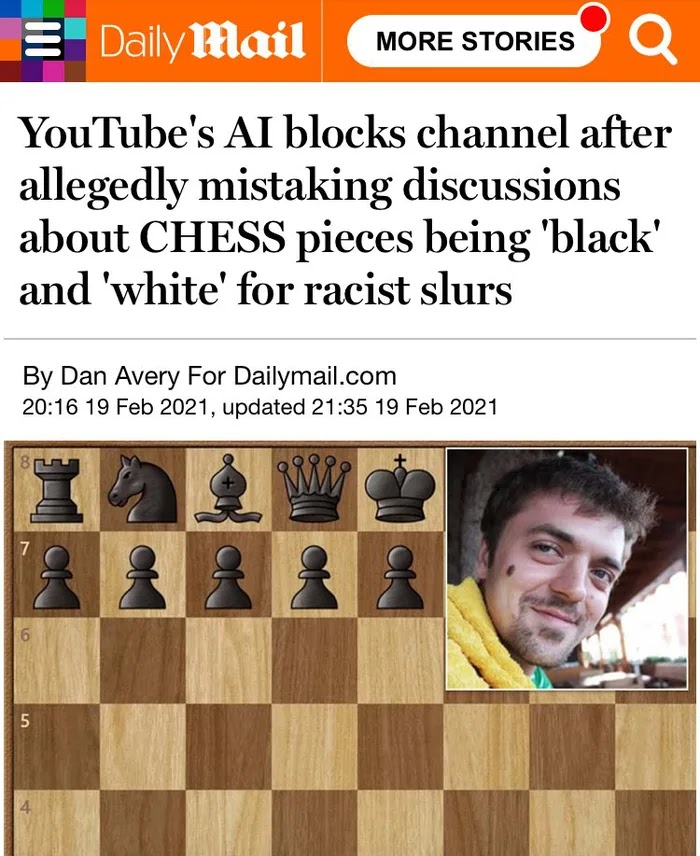
Dan Avery even pointed out the irony of Youtube cancelling one of its top chess channels because chess jargon can sound racist.  You can no longer say, "White is better."

Of course, I take everything Dan Avery says with a grain of salt.  He tried to have my Youtube video cancelled just because I fairly won the 2013 Colorado Springs City Chess Championship over the board.  It was a good thing I saved the video since 5 years after the fact, he accused me of cheating.  Thankfully, the video surveillance and numerous witness show otherwise.


I was just reminded how biting my sarcasm can get when one of my long-time readers was offended.  I really write this blog for two people, LM Brian Wall and Tim Brennan.  I thought for sure, of anyone who actually reads this blog, they would never get their feathers ruffled by my sense of humor.  But when Brian says, "Inappropriate,"  you have hit a home run in cancellation.

From: BrianWall-ChessList 
Sent: Saturday, May 22, 2021 1:58 PM
Subject: Request to mailing list BrianWall-ChessList rejected
 
Your request to the BrianWall-ChessList mailing list

    Posting of your message titled "COATI Uprising"

has been rejected by the list moderator.  The moderator gave the
following reason for rejecting your request:

"Your message was deemed inappropriate by the moderator."

Cancel Chess


[Event "Fast Lane Online"]
[Site "https://cschessnews.blogspot.com/"]
[Date "2021.05.30"]
[Round "3.2"]
[White "Rountree, Brian"]
[Black "Brezina, John"]
[Result "1-0"]
[ECO "C62"]
[WhiteElo "1862"]
[BlackElo "1703"]
[PlyCount "99"]
[EventDate "2021.05.30"]
[TimeControl "600+10"]

1. e4 e5 2. Nf3 Nc6 3. Bb5 d6 4. d4 exd4 5. Nxd4 Bd7 6. Nc3 Qf6 7. Be3 Nge7 8.
O-O a6 9. Ba4 O-O-O 10. a3 Nb8 11. Bxd7+ Nxd7 12. b4 Ne5 13. b5 a5 14. Qe2 b6
15. Rab1 d5 16. f4 Nc4 17. e5 Qh6 18. Bc1 g6 19. f5 Qh4 20. Nf3 Qh5 21. f6 Nf5
22. e6 Bc5+ 23. Rf2 fxe6 24. Qxe6+ Kb8 25. Bf4 Rhe8 26. Qc6 Nfd6 27. Nxd5 Bxf2+
28. Kxf2 Ne4+ 29. Kg1 Qxd5 30. Bxc7+ Ka7 31. Bxd8 Qxc6 32. bxc6 Rxd8 33. c7 Rf8
34. Rd1 Ned6 35. Ne5 Nxe5 36. Rxd6 Nf7 37. Rd7 Kb7 38. Re7 Kc8 39. g4 Nd6 40.
g5 Nb5 41. Rxh7 Nxc7 42. Rg7 Ne6 43. Rxg6 Nd4 44. h4 Nf3+ 45. Kf2 Nxh4 46. Rg7
Nf5 47. Ra7 Nd6 48. Ra8+ Kd7 49. Rxf8 Ke6 50. Rg8 1-0


This Week In Chess


On May 30th, the Colorado Springs Chess Club held the Fast Lane Rapid Online (4SS, G/10+10).  Jose Llacza won the gold, Jeff Fox claimed the silver on tiebreaks, and Vedant Margale and Brian Rountree split the bronze.

Place, Fast Lane Rapid Online, Score

1 "#1 JJ7X (1912)" 3.5
2 "#2 jfoxhoot (1678)" 2.5
3 "#3 KingVed (1543)" 2.5
4 "#3 linuxguy1 (1863)" 2.5
5 "#5 cschessnews (1760)" 2.5
6 "#6 Czechmate1972 (1702)" 1.5
7 "#7 grahamjcjg (781)" 1.0
8 "#8 RishabhNair2 (1040)" 0.0
9 "- RaiderATO (705)" 1.0
10 "- exCityChamp (1907)" 0.0

Friday, August 30, 2019

M&M Battle

Game Of The Week


This week's game comes from the Colorado Springs Chess Club's August Swiss 90 event.  Both Mark McGough & Chris Motley finished their final round pairings quickly.  So, they decided to face off against each other for the 11th time this year.  The match-up is fairly close, with Chris holding a slight edge (+5-4=2).

The McGough & Motley match-up is also battling for the prize of top contributor to the CSCN website for 2019.  Prior to this game, they were tied with 4 published games each and 2 wins each.  This game would settle, once-and-for-all, who is the best contributor for 2019.

Of course, while there can only be one top contributor, it is still a great honor to just be on the list.  I thank all the chess players who created the games that helped make this newsletter such a success for 2019.  And my apologies to anyone who had only losses published.  Better luck in 2020!

Top Contributors for 2019

Rank, Name, Rating, Win/Games

1 Anderson,Paul 1985 6.0/7
2 McGough,Mark 1863 2.0/4
3 Motley,Chris 1528 2.0/4
4 Bozhenov,Alex 1980 2.0/2
5 Harris,Grayson 1490 1.0/3
6 Anderson,Douglas 1.0/2
7 Brown,Joel 1378 1.0/2
8 Kohler,Robert 1658 1.0/1
9 Williams,Scott 1225 1.0/1
10 Bloomer,Josh 2305 1.0/1
11 Andersen,Gunnar 2112 1.0/1
12 Brennan,Tim 1800 1.0/1
13 Barlay,Peter 1735 1.0/1
14 Vispute,Ayush 1309 1.0/1
15 Brown,Jonathan 1320 0.5/1
16 Wolf,Will 1311 0.5/1
17 Fischer,Bobby 0.5/1
18 Reid,Juan 0.5/1
19 Brown,Dean 1444 0.0/3
20 Arispe,Joey 1259 0.0/1
21 MacEnulty,Asher 1118 0.0/1
22 Eads,Clint 1027 0.0/1
23 Williams,Jesse 1731 0.0/1
24 Buchanan,Richard 2000 0.0/1
25 Wall,Brian 2291 0.0/1
26 Aregbeyen,Aigboje 1944 0.0/1
27 Fox,Jeff 1777 0.0/1
28 Svoboda,Erk 1400 0.0/1
29 Herman,Shirley 1075 0.0/1

See diagram on blog
White to move

M&M Battle


[Event "August Swiss 90"]
[Site "https://cschessnews.blogspot.com/"]
[Date "2019.08.27"]
[Round "4.6"]
[White "McGough, Mark"]
[Black "Motley, Chris"]
[Result "1-0"]
[ECO "C45"]
[WhiteElo "1842"]
[BlackElo "1750"]
[PlyCount "137"]
[EventDate "2019.08.06"]
[TimeControl "5400+30"]

1. e4 e5 2. Nf3 Nc6 3. d4 exd4 4. Nxd4 Bc5 5. Nxc6 Qf6 6. Qf3 dxc6 7. Qxf6 Nxf6 8. Bd3 O-O 9. O-O Re8 10. Nd2 b5 11. a4 Rb8 12. Nb3 Bd6 13. axb5 cxb5 14. Be3 a6 15. f3 Nd7 16. Nd4 Bb7 17. Nf5 Bf8 18. Bf4 Ne5 19. Be2 f6 20. Rfd1 g6 21. Ng3 Bc5+ 22. Kf1 Rbc8 23. h4 Nc6 24. c3 Bb6 25. Rd7 Ne5 26. Rd2 c5 27. Rad1 Bc7 28. Bxe5 Bxe5 29. Nh1 Bc6 30. Kf2 Bf4 31. Rc2 Kg7 32. g3 Bb8 33. Kg2 c4 34. Nf2 h5 35. Rcd2 Ba7 36. Rd7+ Bxd7 37. Rxd7+ Kg8 38. Rxa7 Re6 39. Rd7 Rcc6 40. Kf1 a5 41. Rd5 Re5 42. Rd7 b4 43. cxb4 Rb5 44. b3 Rxb4 45. Bxc4+ Kf8 46. Ra7 a4 47. Bd5 Rc1+ 48. Ke2 axb3 49. Nd3 b2 50. Nxb2 Rxb2+ 51. Ke3 Rb6 52. Rf7+ Ke8 53. Rg7 f5 54. Kf4 Kf8 55. Rf7+ Ke8 56. Kg5 fxe4 57. fxe4 Rg1 58. Rf3 Rd6 59. Bf7+ Ke7 60. Bxg6 Re6 61. Kxh5 Rf6 62. Rxf6 Kxf6 63. g4 Re1 64. Kh6 Ke7 65. Kg7 Rc1 66. h5 Ke6 67. Bf7+ Ke5 68. g5 Rg1 69. g6 1-0

https://www.chessvideos.tv/chess-game-replayer.php?id=114652


This Week In Chess


On August 27th, the Colorado Springs Chess Club finished the August Swiss 90 event (4SS, G/90+5).

Standings. August Swiss 90

# Name Rtng Rd 1 Rd 2 Rd 3 Rd 4 Tot Prize

1 Paul D Anderson 1969 D2 W3 W4 W5 3.5 $21.50 1st
2 Christophe Motley 1750 D1 W10 W3 W6 3.5 $21.50 1st
3 Mark McGough 1842 W5 L1 L2 W7 2.0
4 Dean W Brown 1406 U--- D9 L1 W10 1.5 $11.00 U1500/unr
5 Grayson Ed Harris 1612 L3 W6 U--- L1 1.0
6 William Leo Wolf 1300 U--- L5 W9 L2 1.0
7 Jonathan Reinhard 880 H--- H--- U--- L3 1.0
8 Donald Hillman 1095 U--- U--- U--- W9 1.0
9 Kenneth Macrae 1300 U--- D4 L6 L8 0.5
10 Clinton Eads 1283 H--- L2 U--- L4 0.5

Wednesday, July 31, 2019

The Gambler

Game Of The Week


This week's game comes from the Colorado Springs Chess Club's July Mating Game.  This tournament has its origins back in 1991 with a different name, in a different time.  Of course, change is inevitable and, over the course of its 29 year history, the event has morphed into a two-week, four-round, dual-rated tournament (4SS, G/45;d/10).

In the first week, Joel Brown got his loss published because I was looking for a Pin tactic.  He wasn't too happy with me for making his first game in print a loss.  His mood didn't improve when we had a dispute about the prize money.

It all started when Joel played Bishop to c3 with a double attack on the Queen and Rook.  He called me over to his game to claim his prize money.  I told him things look good, but I should wait until the result is official, but, for a taste of your whisky, I'll give you some advice:

You never count your money
When you're sittin' at the table
There'll be time enough for countin'
When the game's done

You see, with an upset win over NM Buck Buchanan, Joel was going to qualify for the 2nd place prize and the Under prize.  While Buck seemed to have this game under control, he went after the left most Pawn.  It was a gamble that didn't pay off.

During the Renaissance period, the rules of chess were changing dramatically with the introduction of the Mad Queen and new names for the pieces.  But these chess innovators also felt the need to name all the Pawns.  The name they gave to the left most Pawn was The Gambler because it is always a risk to capture it.

So, if you want to solve this puzzle, for a taste of your whiskey, I'll give you some advice:

Every player knows
That the secret to survivin'
Is knowin' what to throw away
And knowin' what to keep
'Cause one move's a winner
And every move's a loser

With the position looking bad, the question is, "Do you hold 'em or do you fold 'em?"

See diagram on blog
White to move

The Gambler


[Event "July Mating Game"]
[Site "https://cschessnews.blogspot.com/"]
[Date "2019.07.23"]
[Round "4.3"]
[White "Buchanan, Richard"]
[Black "Brown, Joel"]
[Result "0-1"]
[ECO "B40"]
[WhiteElo "2000"]
[BlackElo "1378"]
[PlyCount "78"]
[EventDate "2019.07.16"]
[TimeControl "2700"]

1. e4 c5 2. Nf3 e6 3. d4 cxd4 4. Nxd4 Nf6 5. Nc3 Bb4 6. Bd3 a6 7. Bd2 e5 8. Nf3 Nc6 9. O-O h6 10. a3 Bc5 11. Nd5 d6 12. c4 Bg4 13. h3 Bxf3 14. Qxf3 Nxd5 15. cxd5 Nd4 16. Qd1 O-O 17. b4 Bb6 18. Be3 Qd7 19. Kh1 Rac8 20. Rb1 Rc3 21. a4 Rfc8 22. b5 a5 23. f4 Ra3 24. Bc1 Rac3 25. Bb2 R3c7 26. fxe5 dxe5 27. Qh5 Qd6 28. Rbc1 Rxc1 29. Qxf7+ Kh8 30. Rxc1 Rf8 31. Qxb7 Rf2 32. Bxd4 Bxd4 33. Qa8+ Kh7 34. Qxa5 Qa3 35. Rd1 Qb3 36. Rd2 Bc3 37. Rxf2 Bxa5 38. Bc2 Qe3 39. Rf8 Qc1+ 0-1

https://www.chessvideos.tv/chess-game-replayer.php?id=114581


This Week In Chess


On July 23rd, the Colorado Springs Chess Club finished the July Mating Game (4SS, G/45;d/10).

Standings. July Mating Game

# Name Rtng Rd 1 Rd 2 Rd 3 Rd 4 Tot Prize

1 Aleksand Bozhenov 1971 W10 W2 W4 W6 4.0 $36.00 1st + GOW
2 Joel N Brown 1378 W5 L1 W7 W9 3.0 $16.50 2nd
3 Christophe Motley 1690 L8 W9 W5 W4 3.0 $16.50 2nd
4 Grayson Ed Harris 1646 W9 W8 L1 L3 2.0
5 Mark McGough 1824 L2 W10 L3 W8 2.0
6 Paul D Anderson 1950 H--- H--- W8 L1 2.0
7 Kenneth Macrae 1264 H--- U--- L2 W10 1.5
8 Jonathan An Brown unr. W3 L4 L6 L5 1.0
9 Richard Buchanan 2000 L4 L3 W10 L2 1.0
10 Dean W Brown 1459 L1 L5 L9 L7 0.0

Monday, July 22, 2019

P Is For Pin VIII

Game Of The Week


A couple years back, I came up with a method to organize chess tactics.  I called it the DROP Method (https://cschessnews.blogspot.com/2012/03/drop-method.html).  The DROP method is an acronym for the basic kinds of tactics.  It is meant to remind you not to drop your pieces and help you get your opponent to drop theirs.

I said that the DROP Method was a work in progress, and it was.  So, I thought I would revisit each of the four kinds of chess tactics to provide more examples.  The first kind of tactic in the DROP Method is Discovery, which I revisited on April 8th (https://cschessnews.blogspot.com/2019/04/d-is-for-discovery-vii.html).  The second kind of tactic in the DROP Method is Removal, which I revisited on May 14th (https://cschessnews.blogspot.com/2019/05/r-is-for-removal-viii.html).  The third kind of tactic in the DROP Method is Overload, which I revisited on May 29th (https://cschessnews.blogspot.com/2019/05/o-is-for-overload-viii.html).

The fourth kind of tactic in the DROP Method is Pin.

Pin is a chess move that immobilizes an opponent's piece.

The Pin is different from the other kinds of tactics in that it does not create multiple threats.  Its main function is to prevent a piece from moving.  A Pin on a target allows that target to be attacked by a lower value piece.  A Pin on a support allows the capture of the piece the support is guarding.

"The defensive power of a pinned piece is only imaginary."

Aaron Nimzovich

The Pin works by threatening a low value piece that has a higher value piece (or an ungarded piece) behind it.  The low value piece is stuck (as if with a pin) to the higher value piece due to the loss of material should the low value piece move and allow the capture of the higher value piece.

If the higher value piece is the King, the low value piece is absolutely immobilized, as the rules of Chess do not allow moves where the King could be captured.  Otherwise the Pin is relative, as the opponent can actually move the low value piece if he is willing to accept the loss of material.  The other types of Pins are rare:

  • Absolute (Pins a target to the King)
  • Relative (Pins a low value target to a higher value piece)
  • Cross (Multiple Pins on one piece)
  • Cross-check (blocks check and counter-checks)

Here is an example from the Colorado Springs Chess Club's Tuesday night event:  July Mating Game.  Alex Bozhenov created the best example of a Pin in his game with Joel Brown this night.  While the Black Pawns on the 3rd rank make this position dominating for Black, taking advantage of the Pin on g2 is by far the best move.

See diagram on blog
Black to move

P Is For Pin VIII


[Event "July Mating Game"]
[Site "https://cschessnews.blogspot.com/"]
[Date "2019.07.16"]
[Round "2.1"]
[White "Brown, Joel"]
[Black "Bozhenov, Alex"]
[Result "0-1"]
[ECO "B07"]
[WhiteElo "1378"]
[BlackElo "1971"]
[PlyCount "74"]
[EventDate "2019.07.16"]
[TimeControl "2700"]

1. e4 d6 2. Bc4 Nf6 3. Nc3 g6 4. d4 Bg7 5. h3 Nxe4 6. Bxf7+ Kxf7 7. Nxe4 Rf8 8. Nf3 Kg8 9. Be3 Nc6 10. Qd2 Bf5 11. Ng3 e5 12. Bg5 Qe8 13. d5 e4 14. Nh2 Ne5 15. Qe2 Nf7 16. Bc1 Qe5 17. c4 c6 18. dxc6 bxc6 19. Nxf5 gxf5 20. O-O d5 21. cxd5 cxd5 22. Rb1 d4 23. b4 d3 24. Qd1 Qd5 25. a4 Rac8 26. Be3 Rc7 27. Bc5 Re8 28. Re1 Rd7 29. Rb3 Re6 30. Nf1 f4 31. Nh2 Rg6 32. Nf3 Bf6 33. Nh2 e3 34. Nf3 e2 35. Rxd3 Qxd3 36. Qxd3 Rxd3 37. Rxe2 Nd6 0-1

https://www.chessvideos.tv/chess-game-replayer.php?id=114553


This Week In Chess


On July 16th, the Colorado Springs Chess Club started the July Mating Game (4SS, G/45;d/10).

Standings. July Mating Game

# Name Rtng Rd 1 Rd 2 Tot Prize

1 Aleksand Bozhenov 1971 W8 W3 2.0
2 Grayson Ed Harris 1646 W7 W4 2.0
3 Joel N Brown 1378 W5 L1 1.0
4 Jonathan An Brown unr. W6 L2 1.0
5 Mark McGough 1824 L3 W8 1.0
6 Christophe Motley 1690 L4 W7 1.0
7 Richard Buchanan 2000 L2 L6 0.0
8 Dean W Brown 1459 L1 L5 0.0

Monday, July 8, 2019

New Mexico Chess Champions: Josh Bloomer

Game Of The Week

By Matt Grinberg


Josh Bloomer won the 2017 New Mexico Open Chess Championship and was thus declared the New Mexico Chess Champion.  He took clear first place with 5.5 out of 6 and raised his rating to an impressive 2326.  His one draw was against Jesse Vicario of Las Cruces in the first round.  In clear second place with 5 was Brian Wall.  Brian lost the fourth round encounter with Josh, but won all his other games.

The outcome was a little unusual since both Josh and Brian live in Colorado.  States that decide their state championship in an open tournament usually specify that while the high scorer is the winner of the tournament, the state champion is the highest scoring player who resides in the state.  That was not done in this case, so Josh was rightfully declared the New Mexico State Chess Champion for 2017.

I had hoped to get a game played by Josh from the 2107 New Mexico Open, but apparently the score sheets were lost along with the NMCO computer that disappeared.  I thought I could get a game by contacting Josh, but an attempt through Facebook got no response.  So, I checked online and found the game below played between Josh Bloomer (White) and Brian Wall (Black) at the 2017 Fall Classic in Denver a month before they finished first and second in the New Mexico Open.  It is curious that the results of the Fall Classic mirrored the results of the New Mexico Open.  Here too Josh finished first giving up only a first round draw and Brian finished second losing only to Josh in round 4.

The game is fascinating!  The opening quickly goes out of book, typical for Brian, but the position looks normal, when Brian hands to Josh a common sacrifice that seems to force a win.  Brian manages to survive the initial onslaught, but when the dust settles Josh is a pawn up with a dominating center and Brian's king is still exposed - seemingly a clear win if Josh simply presses the attack in the center.

But then the game takes another unusual turn.  With all the major pieces on the board and bishops of opposite color and given the nature of the position, conventional wisdom would be that Josh should avoid exchanging major pieces and press home his attack.  The last thing he should do is trade off into a bishops of opposite color endgame where his extra pawn likely would not be enough to win.  And yet Josh deliberately heads for the bishop endgame!

I cannot say that the resulting endgame was a theoretical draw, but it is certainly difficult to find any winning plan other than waiting for Black to make a mistake.  On the other hand, if that was Josh's plan, it worked.  After a lot of maneuvering around, Brian finally makes the mistake that allows Josh's king to get into his position.

Pirc Defense

1. d4 g6 2. Nf3 Bg7 3. e4 d6 4. Bc4 c6 5. Nbd2 d5 6. Bb3 dxe4 7. Nxe4

7... Nd7??

This move amazes me.  Any experienced player would know that you cannot play Nd7 in a position like this.  It invites Josh's sacrifice on the next move because it blocks Black's queen bishop, thus making the e6 square weak.  I have no doubt that an experienced master like Brian is aware of this, but he does it anyway.  Brian has a reputation for playing unusual, provocative moves in the opening, but this is a bit much.

[White has a small edge due to his better center after 7... Nf6 8. Nxf6 Bxf6 9. O-O Bg4 10. Re1 O-O]

See diagram on blog
White to move

8. Bxf7!

[Also winning is the delayed sacrifice.  8. Neg5 Nh6 9. Bxf7! Nxf7 10. Ne6 Qb6 11. Nxg7 Kf8 12. Ne6 Kg8 13. O-O Black is down a pawn and his position is completely disrupted]

8... Kxf7 9. Nfg5!?

[9. Neg5 is better since it retains the option of playing the king knight to e5. 9... Ke8 10. Ne6 Qb6 11. Nxg7 Kf7 12. Ne6 h6 13. Qe2 Qb4 14. Bd2 Qd6 15. Nf4 Nf8 16. Ne5 With an extra pawn, better development and Black's king on the run, White is winning]

9... Ke8 10. Ne6

The reason 7... Nd7 was so bad is it blocked Black's queen bishop, thus making this move possible.

10... Qb6 11. Nxg7 Kf7

Oops!  The knight is trapped!  Perhaps Brian was correct in playing this line after all.

12. Ne6! h6

[Sorry, you can't win back the piece. 12... Kxe6?? 13. Ng5 Kd6 (13... Kf6 14. Qf3 Kg7 15. Qf7 Kh6 16. Ne4 Kh5 (16... g5 17. Bxg5#) 17. Qf3 Kh4 18. Bg5#) 14. Bf4 e5 15. dxe5 1-0, Borngaesser Rene (GER) 2345 - Lodes Hermann (GER) 2147, Germany 1989 15... Ke7 (15... Kc7 16. Ne6 Kb8 17. Qd6 Qc7 18. Qxc7#) 16. Qd6 Kd8 (16... Ke8 17. Qe6 Ne7 (17... Kd8 18. Nf7 Kc7 19. Qd6#) 18. Qf7 Kd8 19. Ne6#) 17. O-O-O c5 18. Ne6 Ke8 19. Nc7 Qxc7 (19... Kd8 20. Bg5 Ne7 21. Bxe7#; 19... Kf7 20. e6 Kf6 21. Ne8 Kf5 22. Rd5 Ne5 23. Qxe5 Kg4 24. Qg5#) 20. Qxc7 White wins]

13. Nf4

[The following is the only other game I know of in this line.  The end of the game is kind of nutty.  White is two pawns up and they are connected passed pawns on the queenside.  Plus White has two more pawns which could be decisive if he can divert Black into defending against the passed pawns.  Yes, the bishop on the open board is better than the knight and Black's king is better than White's king. But I can't see how that compensates for the connected passed pawns.  Even if White were to lose the passed pawns, he is in no danger of losing.  So why did he agree to a draw??? 13. N4c5 Nxc5 14. Nxc5 Nf6 15. O-O Bf5 16. Qe2 Rae8 17. Qc4 Nd5 18. c3 e5 19. dxe5 Rxe5 20. Bf4 Ree8 21. b4 Qb5 22. Qxb5 cxb5 23. Be3 Nxe3 24. fxe3 Kg7 25. Rae1 Re7 26. e4 Rhe8 27. Nxb7 Rxe4 28. Rxe4 Bxe4 29. Nd6 Re6 30. Nxb5 Bd3 31. Nd4 Ra6 32. Rf2 Ra3 33. Nb3 Bb1 34. Rf1 Bf5 35. h3 Rxa2 36. Ra1 Rxa1 37. Nxa1 Kf6 38. Nb3 Be4 39. Nd4 Bd5 40. Nb5 Bc4 41. Nxa7 1/2-1/2, Chudinovskikh, Alexander M (RUS) 2263 - Jansen, Christof (LUX) 2250 , Brno 6/26/2012 It "Duras Open"]

13... Ngf6 14. Nxf6 Nxf6 15. O-O g5 16. Ne2 Bf5 17. Ng3 Bd7?!

Moving the bishop away from the exposed king does not look good.  The king needs all the help he can get.

[Better is 17... Bg6 but even then White has an extra pawn, safer king and better pawn structure]

18. c3 Rae8 19. Re1 Bc8 20. b3 Qd8 21. Qe2 Qd7 22. Bb2 Qg4 23. f3 Qd7 24. Ne4 Nxe4 25. fxe4 Qg4

White has an extra pawn, a dominating center well supported by his pieces and Black's king is still exposed.  The one problem White has is the bishops of opposite color, which makes a win difficult if the major pieces come off the board.  Consequently conventional wisdom would say that White should avoid exchanging major pieces and try to win in the middle game.

26. c4!?

As with Brian's 7th move, this amazes me.  Unlike Brian's move, I can't say this is a mistake, but Josh clearly doesn't believe in conventional wisdom.  The following sequence makes it clear that Josh not only doesn't fear the bishops of opposite color endgame, he actually is playing for a win by trading off to a bishops of opposite color endgame!

There may have been a good reason for this.  The time control was G90+30 and he may have already been short of time.  Josh may have been thinking that trying to win with the major pieces on the board was just too risky.  He may have judged that a substantial risk of a draw in the bishops of opposite endgame was better than a small risk of a loss in the middle game.

[Better is 26. Qe3 Kg6 27. d5! a6 28. c4! Here comes the attack!]

26... Qxe2 27. Rxe2 Rhf8 28. Rf1!?

He continues the plan of trading the major pieces.

[28. d5 is a good alternative]

28... Kg8 29. Ref2 Rxf2 30. Rxf2 Rf8 31. Rxf8!?

The last pair of rooks comes off the board.

[I would prefer 31. Re2 Bg4 32. Re3;

or 31. Rd2 Bd7 32. d5 But it is hard to see how either would lead to a win anyway]

31... Kxf8

So here we are in the bishops of opposite color endgame Josh aimed for.  He still has an extra pawn and a strong center, but there is no clear winning plan.  The problem is that Black's bishop dominates the light squares.  Even if White manages to create a passed pawn, White's king and bishop will easily blockade it.  The next phase of the game sees Josh jockeying for position, but with no detectable plan other than waiting for Brian to make a mistake.

32. Kf2 Bg4 33. Ke3 e6 34. Ba3 Ke8 35. Bd6 Bd1 36. Kd2 Bh5 37. Bb8 a6 38. Be5 Bg6 39. Ke3 h5?!

Black is worried about the two pawns on the same color square as White's bishop, but advancing the pawns when his king and bishop have limited scope has its own risks.

[39... Kf7 is better.  White's bishop is only a threat to Black's kingside pawns while it is e5.  But with Black's king on f7, that is not a threat anyway.  Nor can White's king attack with the bishop on e5 because the king is tied down to defending the e-pawn]

40. g4!?

White hopes he can win both of Black's kingside pawns by giving up the g-pawn.  But it isn't there.

[If White wants to win he should avoid trading off pawns, which only makes the defense easier.  After 40. Bf6 g4 Black's bishop is perpetually tied to the defense of the h-pawn and the squares f4, e5 and g5 have been opened to an invasion by White's king]

40... hxg4 41. Bf6 g3!

A clever move!  He sets up a position where White will not be able to win both pawns without giving up his e-pawn.

42. hxg3 g4

The g-pawn is secure!  If Whites takes it with his king, he will lose his e-pawn.  If he moves the e-pawn forward, then Black's bishop can defend both of his weak pawns from f5.  But on the other hand, with the pawn no longer on g5 the path is now open for White's king to invade via f4.  This is why the whole idea of playing h5 was dubious.

43. Kf4 Bh7 44. Ke5 Kd7 45. a3

With Black's king stuck on d7 and his bishop stuck on g6 and h7, White now embarks on a plan of simply advancing his queenside pawns.  He hopes to either find a way to break through or set up a better position for going after Black's g-pawn.

45... Bg6 46. Bg5 Bh7 47. Bd2 Bg6 48. Bb4 Bh7 49. Bc5 Bg6 50. Kf4 Ke8 51. a4 Bh7 52. a5 Bg6 53. Bd6 Bh7 54. b4 Kd7 55. c5 Ke8

56. Kxg4!

The only way to play for a win.

56... Bxe4 57. Kf4

Now Black has to defend against two serious threats - the advance of the passed g-pawn and an invasion of White's king to attack the b-pawn.  This plus the need to defend the e-pawn will stretch Black's king and bishop to the limit.

57... Bd3 58. Ke5 Kf7 59. Bc7 Bb5?

White's king will now be able to get at Black's queenside pawns.

[He has to stop the invasion of White's king!  59... Ke7 60. Bd6 Kf7 61. g4 Advancing the g-pawn does White no good because Black's king and bishop will always control g6. 61... Bc4 62. Bc7 Ke7 63. g5 Bd3 64. Bd6 Kf7 65. Kf4 Bh7 66. Be5 Bc2 67. Bf6 Ke8 68. Kg4 Bd1 White cannot make progress]

60. Bd8?

As soon as he has it, White lets the win slip away again.

[While he has the chance, he must play 60. Kd6 Kf6 61. Kd7 Bf1 62. Be5 Kf7 63. Kc7 Bb5 64. Kxb7 White will win as in the game]

60... Be2?

The third successive bad move.  This time Josh doesn't let Brian off the hook.

[Black just barely holds after 60... Ke8! 61. Bh4 Kd7 62. g4 Bc4 63. Kf6 Ke8 64. Kg7 Be2 65. g5 Bb5 66. g6 Bd3 67. Be1 Be4 68. Kf6 Bd5 69. g7 e5!  Black gives up another pawn, but still holds because of bishops of opposite color.  70. Kxe5 (70. dxe5 Kd7= The position is drawn so long as Black keeps his king on d7 or e6 and his bishop on the a2 to g8 diagonal.  If White tries to promote the g-pawn by playing Kg6, Black stops him by playing Bg8, and if he tries to advance the e-pawn, Black will always be able to take with the bishop if White's king is defending e6 and he will always be able to take with the king if White's king is elsewhere) 70... Kd7 71. Kf6 Bg8 72. Kg6 Ke6 73. Bg3 Kd7 74. Bf4 Ke6 75. Be5 Ke7 76. d5 Ke8! Whether he takes, pushes or just leaves the pawn where it is, White still cannot make progress]

61. Kd6 Bd1 62. Kc7 Be2 63. Kxb7

Black is two pawns down, all his pawns are weak and White still has that pesky passed g-pawn.  In spite of the bishops of opposite colors, White wins.

63... Bb5 64. Bc7 Kf6 65. Be5 Ke7 66. Kc7 Ba4 67. g4 Bb5 68. g5 Kf7

[68... Ba4 69. Kb6 Bb5 70. g6!  Kf8 The king is forced to give way. 71. Bf6 Now the king can no longer defend the e-pawn. 71... Kg8 72. Kb7 Kf8 (72... Bd3 73. Kxc6 Bxg6 74. Be5 Kf7 75. Kd7 The c-pawn will cost Black his bishop) 73. Kc7 Ba4 74. Kd6 White wins because Black can no longer defend all the pawns]

69. Kd6 Ba4 70. g6 Kxg6 71. Kxe6 Bb5 72. Kd6 Kf7 73. d5! Ke8

[Or 73... cxd5 74. c6 Ke8 75. c7 Bd7 76. b5 Bc8 77. b6 Bb7 78. Ba1 Kf7 79. Kd7 d4 80. Bxd4 Kf8 81. c8=Q Bxc8 82. Kxc8 White wins]

74. Bf6 cxd5 75. c6 d4 76. c7 Bd7 77. Bxd4 Bc8 78. Kc6 Ke7 79. Be5 Ke6 80. Bg3 Ke7 81. Kb6 Kd7 82. Be5 Ke6 83. Bc3 Kd6 84. Bd2 Kd7 85. Bf4 Ke6 86. b5! One of White's pawns will queen. Black resigns. [1:0]

New Mexico Chess Champions: Josh Bloomer


[Event "Fall Classic"]
[Site "https://cschessnews.blogspot.com/"]
[Date "2017.10.08"]
[Round "4.1"]
[White "Bloomer, Josh"]
[Black "Wall, Brian"]
[Result "1-0"]
[ECO "B06"]
[WhiteElo "2305"]
[BlackElo "2291"]
[PlyCount "171"]
[EventDate "2017.10.07"]
[TimeControl "5400+30"]

1. d4 g6 2. Nf3 Bg7 3. e4 d6 4. Bc4 c6 5. Nbd2 d5 6. Bb3 dxe4 7. Nxe4 Nd7 8. Bxf7+ Kxf7 9. Nfg5+ Ke8 10. Ne6 Qb6 11. Nxg7+ Kf7 12. Ne6 h6 13. Nf4 Ngf6 14. Nxf6 Nxf6 15. O-O g5 16. Ne2 Bf5 17. Ng3 Bd7 18. c3 Rae8 19. Re1 Bc8 20. b3 Qd8 21. Qe2 Qd7 22. Bb2 Qg4 23. f3 Qd7 24. Ne4 Nxe4 25. fxe4 Qg4 26. c4 Qxe2 27. Rxe2 Rhf8 28. Rf1+ Kg8 29. Ref2 Rxf2 30. Rxf2 Rf8 31. Rxf8+ Kxf8 32. Kf2 Bg4 33. Ke3 e6 34. Ba3+ Ke8 35. Bd6 Bd1 36. Kd2 Bh5 37. Bb8 a6 38. Be5 Bg6 39. Ke3 h5 40. g4 hxg4 41. Bf6 g3 42. hxg3 g4 43. Kf4 Bh7 44. Ke5 Kd7 45. a3 Bg6 46. Bg5 Bh7 47. Bd2 Bg6 48. Bb4 Bh7 49. Bc5 Bg6 50. Kf4 Ke8 51. a4 Bh7 52. a5 Bg6 53. Bd6 Bh7 54. b4 Kd7 55. c5 Ke8 56. Kxg4 Bxe4 57. Kf4 Bd3 58. Ke5 Kf7 59. Bc7 Bb5 60. Bd8 Be2 61. Kd6 Bd1 62. Kc7 Be2 63. Kxb7 Bb5 64. Bc7 Kf6 65. Be5+ Ke7 66. Kc7 Ba4 67. g4 Bb5 68. g5 Kf7 69. Kd6 Ba4 70. g6+ Kxg6 71. Kxe6 Bb5 72. Kd6 Kf7 73. d5 Ke8 74. Bf6 cxd5 75. c6 d4 76. c7 Bd7 77. Bxd4 Bc8 78. Kc6 Ke7 79. Be5 Ke6 80. Bg3 Ke7 81. Kb6 Kd7 82. Be5 Ke6 83. Bc3 Kd6 84. Bd2 Kd7 85. Bf4 Ke6 86. b5 1-0

https://www.chessvideos.tv/chess-game-replayer.php?id=114478


This Missed Week In Chess


On June 25th, the Colorado Springs Chess Club finished the June Swiss 90 event (4SS, G/90+30).

Standings. June Swiss 90

# Name Rtng Rd 1 Rd 2 Rd 3 Rd 4 Tot Prize

1 Paul D Anderson 1950 W6 W2 W3 W5 4.0 $30.00 1st
2 Mark McGough 1857 W10 L1 W5 W9 3.0 $25.00 2nd + GOW
3 Christophe Motley 1679 W4 W6 L1 U--- 2.0
4 Richard Buchanan 2000 L3 W12 U--- W10 2.0
5 Joey Arispe 1259 W11 H--- L2 L1 1.5 $13.00 U1600/unr
6 Grayson Ed Harris 1534 L1 L3 W9 U--- 1.0
7 William Leo Wolf 1300 U--- W13 U--- U--- 1.0
8 Peter Barlay 1906 W9 U--- U--- U--- 1.0
9 Dean W Brown 1460 L8 D10 L6 L2 0.5
10 Kenneth Macrae 1264 L2 D9 U--- L4 0.5
11 Michael Smith II 1713 L5 H--- U--- U--- 0.5
12 Joseph Griffin 761 U--- L4 U--- U--- 0.0
13 Joy Sato unr. U--- L7 U--- U--- 0.0

Wednesday, July 3, 2019

Surely Free!

Game Of The Week


One score less eight months ago, our chess clubs brought forth on this state, a new petition, conceived in Liberty, and dedicated to the proposition that all men are created to play chess.

IN COLORADO, JULY 4, 2018

The Declaration of the chess clubs of Colorado

When in the Course of human events it becomes necessary for one people to dissolve the social bands which have connected them with another and to assume among the powers of the earth, the separate and equal station to which the Laws of Nature and of Nature's God entitle them, a decent respect to the opinions of mankind requires that they should declare the causes which impel them to the separation.

We hold these truths to be self-evident, that all men are created equal, that they are endowed by their Creator with certain unalienable Rights, that among these are Life, Liberty and the pursuit of Chess.

That to secure these rights, suspensions are applied to Players, deriving their just powers from the consent of the clubs,

That whenever any participant becomes destructive of these ends, it is the Right of the Players to alter or to abolish it, and to institute new suspensions, laying its foundation on such principles and organizing its powers in such form, as to them shall seem most likely to effect their Safety and Happiness.  Prudence, indeed, will dictate that suspensions long established should not be changed for light and transient causes; and accordingly all experience hath shewn that mankind are more disposed to suffer, while evils are sufferable than to right themselves by abolishing the forms to which they are accustomed.  But when a long train of abuses and usurpations, pursuing invariably the same Object evinces a design to reduce them under absolute Despotism, it is their right, it is their duty, to throw off such suspension, and to provide new Guards for their future security.

Such has been the patient sufferance of these Clubs; and such is now the necessity which constrains them to alter their former suspension.  The history of the present Thanos The Mad Titan is a history of repeated injuries and usurpations, all having in direct object the establishment of an absolute Tyranny over these Clubs.  To prove this, let Facts be submitted to a candid world.

  • She was finally banned from the Colorado Springs Scholastic Chess Club after November 2014 when she disrespected the organizer and library security guard who asked her to reprimand a child under her supervision for vandalizing a public restroom.
  • She was finally banned from the Colorado Springs Chess Club on July 12th, 2016 for the remainder of the year when she showed poor sportsmanship and disrespect to the players in the tournament hall by engaging in a profane rant about refusing to sign for a tournament prize.
  • She was finally banned from the Denver Chess Club on May 19th, 2018 for the remainder of the year when she disrespected the club with disparaging comments via various social media outlets.
  • After nearly a year of unrelenting, self-published attacks and dishonesty (even creating an impostor Facebook page with the club's name), repeated attempts to dissuade players from participation (even bribing a Master to not enter a tournament), and constant character defamation of its founders and directors (even those who are Junior chess players and minors), she was finally banned from Club Chess!! in May, 2018 pending formal investigation into the Denver Chess Club's ban.

In every stage of these Oppressions We have Petitioned for Redress in the most humble terms:  Our repeated Petitions have been answered only by repeated injury.  A Player, whose character is thus marked by every act which may define a Mad Titan, is unfit to be a participant or a director of a chess event.

We, therefore, the Representatives of the chess clubs of Colorado, in an open letter, written, appealing to the Colorado State Chess Association for the rectitude of our intentions, do, in the Name, and by Authority of the good Players of these clubs, solemnly publish and declare, That these united clubs are, and of Right ought to be Free and Independent Clubs, that they are Absolved from all Allegiance to Thanos The Mad Titan, and that all playing privileges and tournament direction between them and Thanos The Mad Titan, is and ought to be totally dissolved (for the period of one year); and that as Free and Independent Clubs, they have full Power to remove players who demonstrate a pattern of poor sportsmanship, dishonesty, and disrespect for the rights of others.

And for the support of this Declaration, with a firm reliance on the protection of Divine Providence, we mutually pledge to each other our Lives, our Fortunes, and our sacred Honor.

Sunday, June 9, 2019

Overworked & Underpaid

Game Of The Week


This week's game comes from the Colorado Springs Chess Club's June Swiss 90 (4SS, G/90+30) event.  This tournament is a month-long event with one game per week.  I like the one-game-per-week format because it is easier to direct and play.  Not easy, just easier, but I prefer playing.  I do not prefer being the tournament director (TD).

Being a TD is a thankless job.  There is no fame.  There is no fortune.  It is just work, but I do want to keep the club going.  I feel like the Godfather.

"Just when I thought I was out, they pull me back in."
Michael Corleone, The Godfather Part III

I can get most of the directing duties done at the beginning of the night and eventually focus on playing chess.  Well, at least, that is my hope.

Since this was the first Tuesday in June, it was round one.  I am always hopeful that my round one pairing will be an easy game because the first week of a tournament is more hectic as the TD.  It was not.

I was playing Grayson Harris again.  We met in the 4th round of the May Swiss 90, where he got behind in the opening, fought hard, and couldn't quite come back.  This time, it was my turn to fall behind and see if I could come back.  I used up a lot of time trying to figure out a plan to get my Pawn back.

Just when I thought I was won, Grayson pulled out Qa5.

Now, I was low on time and fighting to hold the draw.  When I reached this position, I wasn't thinking tactically and missed the killer move.  However, I held the draw as long as I could, and, with a minute left, I took a shot.

Just when I thought I was drawn, I pulled out a win.

See diagram on blog
White to move

Overworked & Underpaid


[Event "June Swiss 90"]
[Site "https://cschessnews.blogspot.com/"]
[Date "2019.06.04"]
[Round "1.2"]
[White "Anderson, Paul"]
[Black "Harris, Grayson"]
[Result "1-0"]
[ECO "D10"]
[WhiteElo "1950"]
[BlackElo "1534"]
[PlyCount "103"]
[EventDate "2019.06.04"]
[TimeControl "5400+30"]

1. d4 d5 2. c4 c6 3. g3 dxc4 4. Bg2 Nf6 5. Nf3 Bf5 6. O-O Nbd7 7. Nbd2 Nb6 8. Nh4 Bg4 9. h3 Bh5 10. g4 Bg6 11. Nxg6 hxg6 12. e3 Qc7 13. Qf3 e5 14. Ne4 Be7 15. Bd2 exd4 16. exd4 Nbd5 17. Rfe1 O-O 18. Rac1 b5 19. Nc3 Rad8 20. Re2 Rfe8 21. Rce1 a6 22. Bg5 Kf8 23. Re5 Rd7 24. Bxf6 gxf6 25. Nxd5 cxd5 26. Rxd5 Rxd5 27. Qxd5 Qa5 28. Qe4 Qxa2 29. Re2 c3 30. bxc3 Qa1+ 31. Bf1 Qxc3 32. Qb7 Qc8 33. Qa7 Qa8 34. Qxa8 Rxa8 35. Ra2 a5 36. Bxb5 Bb4 37. d5 Ke7 38. Kg2 Kd6 39. Bc6 Ra7 40. Kf3 Ke7 41. Ke4 Kf8 42. Kd4 Kg7 43. Kd3 Kh6 44. f4 f5 45. Ke3 fxg4 46. hxg4 f5 47. gxf5 gxf5 48. Kf3 Kh5 49. Re2 a4 50. Re6 Bf8 51. Be8+ Kh4 52. Re1 1-0

https://www.chessvideos.tv/chess-game-replayer.php?id=114401


This Week In Chess


On June 6th, the Colorado Springs Chess Club started the June Swiss 90 event (4SS, G/90+30).

Standings. June Swiss 90

# Name Rtng Rd 1 Tot Prize

1 Paul D Anderson 1950 W8 1.0
2 Peter Barlay 1906 W9 1.0
3 Mark McGough 1857 W10 1.0
4 Christophe Motley 1679 W6 1.0
5 Joey Arispe 1259 W7 1.0
6 Richard Buchanan 2000 L4 0.0
7 Michael Smith II 1713 L5 0.0
8 Grayson Ed Harris 1534 L1 0.0
9 Dean W Brown 1460 L2 0.0
10 Kenneth Macrae 1264 L3 0.0

Tuesday, May 14, 2019

R Is For Removal VIII

Game Of The Week


A couple years back, I came up with a method to organize chess tactics. I called it the DROP Method (https://cschessnews.blogspot.com/2012/03/drop-method.html).  The DROP method is an acronym for the basic kinds of tactics.  It is meant to remind you not to drop your pieces and help you get your opponent to drop theirs.

I said that the DROP Method was a work in progress, and it was.  So, I thought I would revisit each of the four kinds of chess tactics to provide more examples.  The first kind of tactic in the DROP Method is Discovery, which I revisited on April 8th (https://cschessnews.blogspot.com/2019/04/d-is-for-discovery-vii.html).  The second kind of tactic in the DROP Method is Removal.

Removal is a chess move that attacks a support.

The Removal is played when the player stops an opponent's piece from supporting the actual target.  The supporting piece will typically be of an equal or lesser value than the attacking piece.  However, the Removal can give up material, as the protection on the real target is now gone and creates a second attack that cannot be defended.

The target can be the King (Mate threat), a valuable piece (Material threat), or even a square (Mobility threat).

Different types of Removals are referred to by different names, but the idea is the same:  The support of the target is removed.  Here are some names for the different types of Removal:

  • Clearance (Removal by passing support)
  • Deflection (Removal by forcing support to move)
  • Interference (Removal by interposition; Interception)
  • Undermining (Removal by capturing support; trade)
  • Sacrifice (Removal by capturing support; Exchange; Greek Gift, Desperado)

Here is an example from an email match I played with my Dad.  I think I was nervous about playing the tactic here because of Black's counter-play.  So, I tried to prepare it with 16. Re1.  Can you find the better move?

See diagram on blog
White to move

R Is For Removal VIII


[Event "2-4"]
[Site "https://cschessnews.blogspot.com/"]
[Date "1997.05.05"]
[Round "?"]
[White "Anderson, Paul"]
[Black "Anderson, Douglas"]
[Result "1-0"]
[ECO "D43"]
[PlyCount "109"]
[EventDate "1997.03.07"]
[TimeControl "0"]

1. d4 d5 2. c4 c6 3. Nc3 e6 4. Nf3 Nf6 5. Bg5 Be7 6. e3 O-O 7. c5 b6 8. b4 Nbd7 9. Bd3 a5 10. a3 h6 11. Bh4 Bb7 12. O-O b5 13. Bc2 Nh7 14. Bxe7 Qxe7 15. e4 e5 16. Re1 axb4 17. axb4 Rxa1 18. Qxa1 Ng5 19. Nxe5 Nxe5 20. dxe5 Rd8 21. exd5 cxd5 22. Nxb5 Ne6 23. Nd6 Bc6 24. Qd1 Qg5 25. b5 Bxb5 26. Nxb5 Nxc5 27. Nd6 Ne6 28. Bh7+ Kf8 29. Qxd5 g6 30. Rf1 Kg7 31. f4 Qe7 32. f5 Kxh7 33. fxe6 fxe6 34. Qe4 Qa7+ 35. Kh1 Rd7 36. h3 Rg7 37. Qf4 g5 38. Qf6 Qd7 39. Qf7 Qxf7 40. Rxf7 Rxf7 41. Nxf7 Kg6 42. Nd6 g4 43. Kh2 Kg5 44. g3 gxh3 45. Kxh3 h5 46. Nc4 Kf5 47. Kh4 Kg6 48. Nd6 Kh6 49. Nf7+ Kg6 50. Ng5 Kf5 51. Kxh5 Kxe5 52. Kg4 Kf6 53. Ne4+ Ke5 54. Kf3 Kf5 55. g4+ 1-0

https://www.chessvideos.tv/chess-game-replayer.php?id=114313


This Week In Chess


On May 7th, the Colorado Springs Chess Club started the May Swiss 90 event (4SS, G/90+30).

Standings. May Swiss 90

# Name Rtng Rd 1 Tot Prize

1 Brian Jo Rountree 1962 W5 1.0
2 Paul D Anderson 1950 W6 1.0
3 Mark McGough 1823 W7 1.0
4 Christophe Motley 1662 W8 1.0
5 Grayson Ed Harris 1466 L1 0.0
6 Ayush Vispute 1365 L2 0.0
7 Clinton Eads 1291 L3 0.0
8 Daniel Rupp 1076 L4 0.0

Wednesday, April 24, 2019

Bobby Has Left The Springs

Game Of The Week


One of the biggest chess controversies in Colorado Springs is whether or not Bobby Fischer ever played here.  On one side is the 1st Colorado Springs City Chess Champion (Francis Mason).  On the other side is the 22nd Colorado Springs City Chess Champion (NM Buck Buchanan).

Francis Mason claims to have played Bobby Fischer when he came to Colorado Springs.  As he was sharing the game of Kings with his son, Curtis Mason, he included his encounter with the King of Kings in his chess war stories.  Of course, Curtis passed along this information with any chess player who was willing to listen.

"No!" Buck shook his head gruffly.  "Never happened.  Bobby has never been to Colorado Springs."

Now, on the 55th anniversary, new evidence has appeared that proves once and for all that Bobby Fischer was in Colorado Springs in 1964.

This article appeared on page 1 of the Colorado Springs Gazette Telegraph from September 2nd, 1972 and recounts the events of the 1964 Bobby Fischer Simul at the Broadmoor.

See image on blog

"Juan, President of the Colorado Springs Chess Club for many years, was ranked as one of the strongest players in Colorado.

In the Fischer-Reid game below, players will note that Reid was a pawn up and in a strong position at move thirty.  But he believed that Bobby's vast experience would beat him in the end game and so he offered a draw.  The international grandmaster accepted instantly, with a grin."

Marshall Sprague, Colorado Springs Sun

See image on blog

See diagram on blog
White to move

Bobby Has Left The Springs


[Event "1964 Broadmoor Simul"]
[Site "https://cschessnews.blogspot.com/"]
[Date "1964.04.28"]
[Round "?"]
[White "Fischer, Bobby"]
[Black "Reid, Juan"]
[Result "1/2-1/2"]
[ECO "C41"]
[PlyCount "60"]
[EventDate "1964.04.28"]
[TimeControl "0"]

1. e4 e5 2. Nf3 d6 3. d4 Nf6 4. Nc3 exd4 5. Nxd4 Be7 6. f3 Nbd7 7. Be3 Ne5 8. Qd2 c5 9. Bb5+ Bd7 10. Nf5 O-O 11. Bxd7 Qxd7 12. O-O-O Nc4 13. Qe2 Nxe3 14. Qxe3 Rfd8 15. g4 Bf8 16. e5 Ne8 17. Ne4 Qc7 18. exd6 Nxd6 19. Nexd6 Bxd6 20. Nxd6 Rxd6 21. Rxd6 Qxd6 22. Rd1 Qxh2 23. Qe7 Qb8 24. Rd7 Qf4+ 25. Kb1 g6 26. Qe2 b6 27. a3 a6 28. Qd3 b5 29. Qd5 Re8 30. Ka2 Re5 1/2-1/2

https://www.chessvideos.tv/chess-game-replayer.php?id=114257


This Week In Chess


On April 23rd, the Colorado Springs Chess Club finished the April Quick Six event (6SS, G/24+5).

Standings. April Quick Six

# Name Rtng Rd 1 Rd 2 Rd 3 Rd 4 Rd 5 Rd 6 Tot Prize

1 Gunnar Andersen 2102 W13 W7 W3 W8 D2 W4 5.5 $37.00 1st
2 Aleksand Bozhenov 1891 L9 W5 W8 W3 D1 W7 4.5 $25.00 2nd
3 Paul D Anderson 1939 W6 W4 L1 L2 W9 W8 4.0
4 Mitchell Anderson 1887 W12 L3 W13 W7 W5 L1 4.0
5 Brian Jo Rountree 1669 H--- L2 W11 W9 L4 W13 3.5
6 Joel Brown 1334 L3 W12 L7 D10 W15 W11 3.5 $16.00 U1500
7 Mark McGough 1722 W11 L1 W6 L4 W12 L2 3.0
8 Earle P Wikle 1888 W15 W9 L2 L1 W10 L3 3.0
9 Ayush Vispute 1228 W2 L8 W14 L5 L3 W12 3.0
10 Christophe Motley 1526 H--- H--- H--- D6 L8 W15 3.0
11 Jonathan Brown unr. L7 D14 L5 W15 W13 L6 2.5 $5.00 GOW
12 Grayson Ed Harris 1007 L4 L6 W15 W13 L7 L9 2.0
13 Dean W Brown 1400 L1 W15 L4 L12 L11 L5 1.0
14 William Leo Wolf 1311 U--- D11 L9 U--- U--- U--- 0.5
15 Clinton Eads 1027 L8 L13 L12 L11 L6 L10 0.0

Wednesday, April 3, 2019

The Scandinavian

Game Of The Week


This week's game comes from the March Swiss 90, round 4.  It was played by Alex Bozhenov and Jesse Williams.  They have played 36 times before.  27 in the past year!  They are on pace to break my personal best of 87 USCF-rated games against Mark McGough.

This time Jesse tried the Scandinavian Defense: 1.e4 d5

I can't remember ever playing this opening myself.  However, I am curious about trying it, as I am 1/4th Swedish and 1/8th Norwegian (37.5% Scandinavian).  Also, my son just took a genetic test and found out he is 20.6% Scandinavian.

I have played the English, but if there are other openings you think I should try, let me know.  Here are my genetic proclivities:

  • 3/8th German
  • 1/4th Swedish
  • 3/16th English
  • 1/8th Norwegian
  • 1/16th Irish (just a wee bit Irish)

I am guessing that Jesse has very little Scandinavian DNA, as he did little justice to this defense against Bozhenov's attack.  It was like the Russians pulling the Swedish King out of Finland in 1809.

See diagram on blog
White to move

The Scandinavian


[Event "March Swiss 90"]
[Site "https://cschessnews.blogspot.com/"]
[Date "2019.03.26"]
[Round "4.2"]
[White "Bozhenov, Alex"]
[Black "Williams, Jesse"]
[Result "1-0"]
[ECO "B01"]
[WhiteElo "1980"]
[BlackElo "1731"]
[PlyCount "37"]
[EventDate "2019.03.05"]
[TimeControl "5400+30"]

1. e4 d5 2. exd5 Qxd5 3. Nc3 Qd8 4. d4 Bf5 5. Nf3 Nf6 6. Bc4 e6 7. O-O Be7 8. Bb3 a6 9. Ne5 Nbd7 10. Qf3 c6 11. Nxf7 Bg4 12. Nxd8 Bxf3 13. Nxe6 Bd5 14. Nc7+ Kd8 15. N3xd5 cxd5 16. Nxd5 Rc8 17. Nxe7 Kxe7 18. Re1+ Kd8 19. Bf4 1-0

https://www.chessvideos.tv/chess-game-replayer.php?id=114150


This Week In Chess


On March 26th, the Colorado Springs Chess Club finished its March Swiss 90 (4SS, G90+30).

Standings. March Swiss 90

# Name Rtng Rd 1 Rd 2 Rd 3 Rd 4 Tot Prize

1 Paul D Anderson 1985 W10 D4 W5 D3 3.0 $19.00 1st
2 Aleksand Bozhenov 1980 W12 L5 W4 W8 3.0 $19.00 1st
3 Brian Jo Rountree 1869 W13 H--- W8 D1 3.0 $19.00 1st
4 Christophe Motley 1599 W11 D1 L2 W10 2.5
5 Josh S Bloomer 2323 W9 W2 L1 U--- 2.0
6 Grayson Ed Harris 1490 W14 L8 W7 U--- 2.0 $15.00 u1500 + $5.00 GOW
7 Mark McGough 1863 H--- H--- L6 W12 2.0
8 Jesse Williams 1731 H--- W6 L3 L2 1.5
9 Ross Inman 1481 L5 D12 W11 U--- 1.5
10 Dean W Brown 1444 L1 L11 W12 L4 1.0 $5.00 GOW
11 Scott Ch Williams 1225 L4 W10 L9 U--- 1.0 $5.00 GOW
12 Gerald Mena 1362 L2 D9 L10 L7 0.5
13 Clinton Eads 1307 L3 H--- U--- U--- 0.5
14 Nick A Curott 1161 L6 U--- U--- U--- 0.0

Monday, March 18, 2019

Scottch ROOM Attack

Game Of The Week


This week's game comes from the March Swiss 90, round 2.  It was played by Dean Brown and Scott "Scottch" Williams.  They have faced each other 14 times in rated chess.  Scottch needed this game to pull even with a +7-7=1 score.

Dean helped out with Scottch's quest by getting his Bishop trapped and going down material.  However, Scottch didn't just trade down to a winning endgame.  He kept looking for the best moves when he ran across a nice attack in this position.

See diagram on blog
Black to move

I came up with a method to simplfy the list of tactics called the DROP Method.  Each letter in the acronym stands for each of the different basic kinds of tactics:  D = Discovery, R = Removal, O = Overload, and P = Pin.

Getting good at chess means combining the basic tactics into a pattern that is hard to comprehend and wins material or mates.

These tactial combinations often get a new name, as if they are a brand new tactic.  However, it is just the same stuff in a different wrapper.

The thing that hath been, it is that which shall be; and that which is done is that which shall be done: and there is no new thing under the sun.

Ecclesiastes 1:9 (KJV)

So, here is my new wrapper:  The Scottch ROOM attack.

This tactical combination comes from "Scottch" Williams who took the above position and added a few basic tactics to come up with a new brew.

19...Bxh2+!! starts the newly minted Scottch ROOM attack with a Removal = R
20.Kxh2 Qh4+ an Overload occurs by the Queen attacking the King and Pawn = O
21.Kg1 Qxf2+ another Overload occurs when 2 pieces attack a once-guarded piece = O
22.Kh2 Rf5 a Mating Attack forces the material gain = M
23.Qxf5 exf5

And please turn out the lights out after leaving the ROOM.

Scottch ROOM Attack


[Event "March Swiss 90"]
[Site "https://cschessnews.blogspot.com/"]
[Date "2019.03.12"]
[Round "2.5"]
[White "Brown, Dean"]
[Black "Williams, Scott"]
[Result "0-1"]
[ECO "C10"]
[WhiteElo "1444"]
[BlackElo "1225"]
[PlyCount "46"]
[EventDate "2019.03.05"]
[TimeControl "5400+30"]

1. e4 e6 2. d4 d5 3. Nc3 a6 4. Nf3 Nf6 5. Bg5 Be7 6. Bxf6 Bxf6 7. e5 Be7 8. Bd3 c5 9. O-O Nc6 10. Ne2 c4 11. Bxc4 dxc4 12. c3 O-O 13. Qd2 f6 14. exf6 Bxf6 15. Rad1 Ne7 16. Rfe1 Nd5 17. Ne5 Bg5 18. Qc2 Bf4 19. Nxc4 Bxh2+ 20. Kxh2 Qh4+ 21. Kg1 Qxf2+ 22. Kh2 Nf4 23. Ne3 Rf6 0-1

https://www.chessvideos.tv/chess-game-replayer.php?id=114061


This Week In Chess


On March 12th, the Colorado Springs Chess Club continued its March Swiss 90 (4SS, G90+30).

Standings. March Swiss 90

# Name Rtng Rd 1 Rd 2 Tot Prize

1 Josh S Bloomer 2323 W9 W6 2.0
2 Christophe Motley 1599 W8 D3 1.5
3 Paul D Anderson 1985 W12 D2 1.5
4 Jesse Williams 1731 H--- W7 1.5
5 Brian Jo Rountree 1869 W11 H--- 1.5
6 Aleksand Bozhenov 1980 W10 L1 1.0
7 Grayson Ed Harris 1490 W13 L4 1.0
8 Scott Ch Williams 1225 L2 W12 1.0
9 Ross Inman 1481 L1 D10 0.5
10 Gerald Mena 1362 L6 D9 0.5
11 Clinton Eads 1307 L5 H--- 0.5
12 Dean W Brown 1444 L3 L8 0.0
13 Nick A Curott 1161 L7 U--- 0.0

Top Ten